| License Type | Government Fee (PKR) | NADRA Processing Fee (PKR) | Total Cost (PKR) | Tax Filer Discount Eligibility |
|---|---|---|---|---|
| Prohibited Bore (PB) | 25,000 | 3,000 | 28,000 | 50% discount on government fee for filers with ≥ PKR 100,000 tax paid |
| Non-Prohibited Bore (NPB) | 12,500 | 1,500 | 14,000 | 50% discount on government fee for filers with ≥ PKR 50,000 tax paid |
| New NPB License (Punjab) | 50,000 (approx.) | 3,000 | 53,000 (approx.) | Varies based on provincial regulations |
| Annual Renewal (Punjab) | 2,000 | 2,000 | 4,000 | Not applicable |
| Heavy Weapon Stamp Fee | Varies | — | 2,000 (approx.) | Not applicable |
If you are a gun owner in Pakistan or looking to acquire a firearm for personal safety or sport, understanding the legal and financial requirements is crucial. The National Database and Registration Authority (NADRA), in collaboration with the Ministry of Interior and provincial governments, manages the issuance and renewal of arms licenses.
However, the cost of ownership isn’t static. In recent years, fees have been revised significantly, with distinct charges for new applications, renewals, and different categories of weapons. Whether you are applying for a Non-Prohibited Bore (NPB) license or managing a Prohibited Bore (PB) permit, navigating the fee structure can be confusing due to the split between government levies and NADRA processing charges.
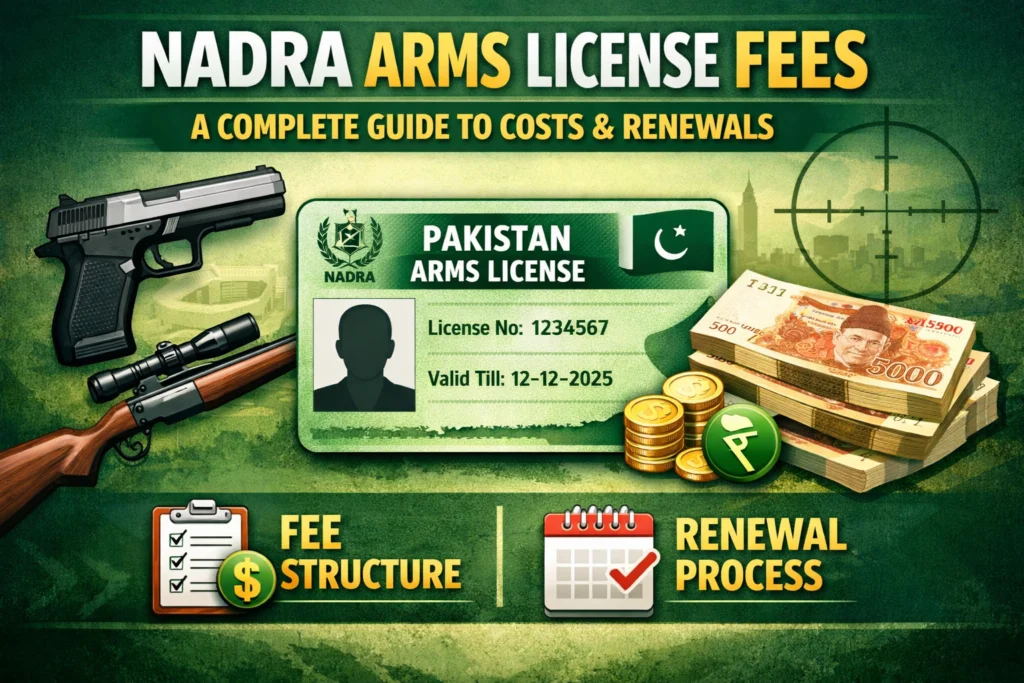
This guide provides a detailed breakdown of the Nadra arms license fees for 2026, the application process, and what you need to know about renewal costs across Pakistan.
Fee Components
Before looking at the total numbers, it is important to understand how the fee is calculated. When you pay for an arms license in Pakistan, your payment generally consists of two distinct parts:
- Government Fee: This is the revenue collected by the federal or provincial government (depending on the license scope). This constitutes the bulk of the cost.
- NADRA Processing Fee: This is the service charge paid to NADRA for handling data entry, biometric verification, and card printing.
It is also vital to note that fees can vary depending on whether the license is valid for all of Pakistan or restricted to a specific province like Punjab or Sindh.
Fee Structure for 2026 (Estimated)
Based on the latest available data and recent revisions, the fee structure for 2026 is categorized by the type of weapon. The two main categories are Prohibited Bore (PB) and Non-Prohibited Bore (NPB).
Prohibited Bore (PB) Licenses
PB licenses are generally restricted and issued only under specific conditions or to authorized personnel. These cover automatic weapons and specific calibers.
- Government Fee: Approximately PKR 25,000
- NADRA Processing Fee: Approximately PKR 3,000
- Total Estimated Cost: PKR 28,000
Tax Filer Incentive:
The government offers a significant incentive for active tax filers. If you are a filer and have paid tax equal to or exceeding PKR 100,000, you may be eligible for a 50% discount on the government fee component.
Non-Prohibited Bore (NPB) Licenses
This is the most common category for civilians, covering semi-automatic pistols, shotguns, and rifles used for protection and hunting.
- Government Fee: Approximately PKR 12,500
- NADRA Processing Fee: Approximately PKR 1,500
- Total Estimated Cost: PKR 14,000
Tax Filer Incentive:
Similar to the PB category, filers who have paid tax equal to or exceeding PKR 50,000 can receive a 50% discount on the government fee.
Note: These figures are indicative and subject to change based on federal budget announcements and provincial policy shifts. Always verify the exact amount at the time of application.
Provincial Variations: The Case of Punjab
While NADRA handles the technical issuance of the card, provincial governments determine the regulatory fees for provincial licenses. Punjab, being the most populous province, has seen specific adjustments in its fee structure.
Recent updates indicate a trend toward higher costs for gun ownership in Punjab:
- New NPB License: The government fee alone has seen hikes in previous years, reaching up to PKR 50,000 in some contexts, plus the standard NADRA processing fee of roughly PKR 3,000.
- Annual Renewals: Unlike the previous system where licenses were often renewed every five years, new rules in Punjab have shifted toward annual renewals.
- Renewal Cost: The annual renewal fee typically involves a government fee of PKR 2,000 plus a NADRA processing fee of PKR 2,000.
If you own a heavy weapon, you may also be required to pay additional stamp paper fees, often costing around PKR 2,000.
How to Apply for and Renew Your License
NADRA has digitized much of the process to make it more transparent and accessible. You no longer need to rely solely on agents or long queues for every step of the process.
1. Online Verification and Management
You can verify the status of your license and manage renewals through online platforms.
- NADRA Technologies: The official NADRA website allows for verification of existing licenses.
- The Dastak Platform: This is a newer initiative designed to bring government services to your doorstep. Through Dastak, applicants can facilitate renewals and other management tasks with greater convenience.
2. NADRA Registration Centers (NRC)
For new applications, physical presence is usually required for biometric verification.
- Visit your nearest NADRA NRC designated for arms licenses.
- Bring your original CNIC and the approval letter from the Ministry of Interior or the relevant Home Department.
- Pay the required fees at the counter.
- Complete the biometric verification and photography.
3. Mobile App
The NADRA Mobile App is another tool that simplifies the payment and tracking process. It allows users to view their details and stay updated on their application status.
Frequently Asked Questions (FAQ)
Can I apply for an arms license online?
While you can manage renewals and verify details online, the initial application for a new license generally requires a physical visit to a NADRA center for biometrics. However, services like the Dastak app are increasingly bridging this gap for renewals and modifications.
What is the difference between an All Pakistan and a Provincial license?
An “All Pakistan” license is issued by the Federal Ministry of Interior and allows you to carry the weapon anywhere in the country. A provincial license is issued by the provincial Home Department (e.g., Punjab or Sindh) and is generally valid only within that province.
Are the fees for tax filers different?
Yes. The government encourages tax compliance by offering significant discounts (up to 50%) on the government fee component of the arms license cost for active tax filers who meet specific tax payment thresholds.
What documents are required for renewal?
Typically, you need your original CNIC, the original arms license card, and the renewal application form. If your license has expired for a significant period, you may also need to pay a penalty.
Stay Legally Compliant
Owning a firearm is a significant responsibility that comes with strict legal obligations. The increase in fees reflects the government’s effort to regulate arms density and ensure that ownership is tracked responsibly.
Failure to renew your license on time can result in penalties, confiscation of the weapon, or cancellation of the license. With the shift toward annual renewals in major provinces like Punjab, it is more important than ever to mark your calendar and budget for these recurring costs.
For the most accurate and real-time fee structures, always consult the official NADRA website or visit your local Deputy Commissioner’s office. Staying informed ensures that you remain a responsible and law-abiding gun owner in Pakistan.