
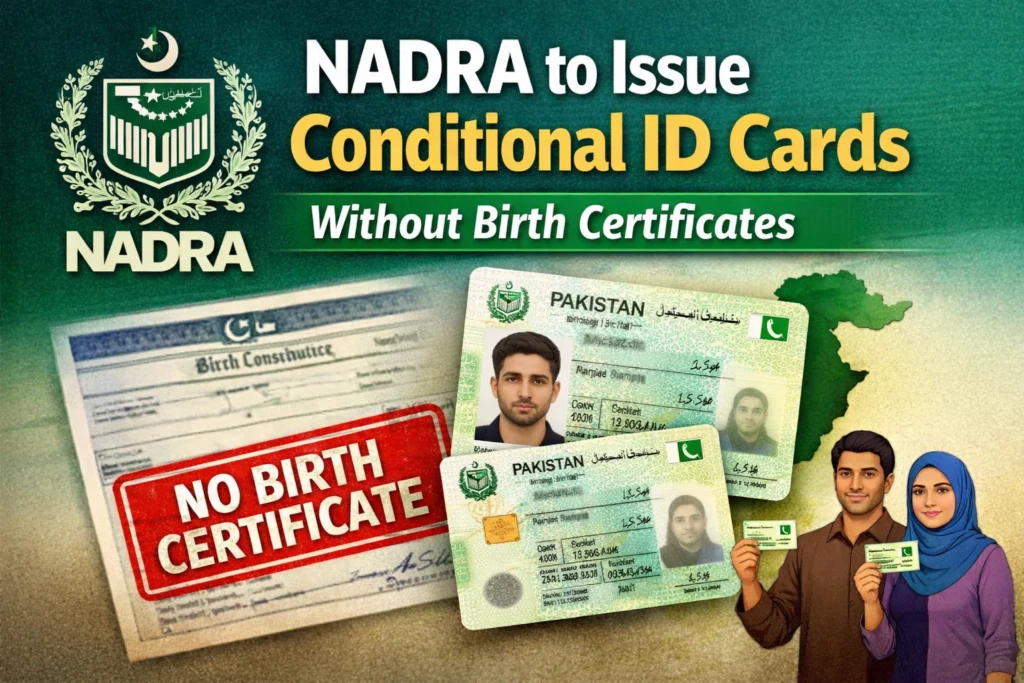
The National Database and Registration Authority (NADRA) has introduced a significant policy shift that addresses a longstanding barrier for many Pakistani citizens. Under new directives from Interior Minister Mohsin Naqvi, NADRA will now issue national identity cards to eligible applicants who do not possess birth certificates a move that could help thousands secure official documentation.
Nadra Birth Certificate Requirement
This conditional facility, approved by NADRA’s Authority Board under the NADRA Ordinance and national identity card regulations, is part of a broader effort to close documentation gaps across the country. The facility will remain in effect until December 31, 2026, and applies specifically to first-time registrants whose identities can be verified through alternative methods.
For many Pakistanis, particularly those in rural or underserved areas, obtaining a birth certificate has been a major hurdle in accessing essential services. This policy change represents a practical solution, though it comes with specific requirements and conditions that applicants must meet.
Who Is Eligible for the Conditional Facility?
NADRA has outlined clear eligibility criteria based on age, gender, and marital status. Understanding these requirements is essential for anyone seeking to register without a birth certificate.
Married Women Aged 18 and Above
Married women applying for a national identity card must present a valid marriage certificate. Both parents and the applicant’s husband must hold valid identity cards. Biometric verification of relevant family members typically parents or spouse will be mandatory to confirm identity and familial relationships.
Unmarried Women
For unmarried women, the requirement to present a husband’s identity card does not apply. However, they must still provide their parents’ valid identity cards and undergo biometric verification of at least one parent to establish their identity.
Men Aged 24 and Above
Male applicants aged 24 or older must provide the identity card of at least one parent and one sibling.One parent’s biometric verification will be required. This ensures that the applicant’s identity is cross-referenced with existing family records in NADRA’s database.
Special Provisions for Deceased Family Members
NADRA has also made accommodations for cases where parents or a spouse are deceased. If both parents and the husband have passed away but their records exist in NADRA’s database, biometric verification requirements may be waived. This provision offers relief to applicants who might otherwise be unable to meet the standard verification criteria.
Key Features of the New Policy
The policy introduces several important features designed to streamline the registration process while maintaining security and accuracy.
Free Non-Smart National Identity Cards
First-time applicants who register under this facility will receive a non-smart national identity card at no charge. This removes a financial barrier and encourages eligible citizens to complete their registration.
Identity Verification Through Alternative Methods
Without a birth certificate, NADRA will rely on biometric verification and cross-referencing with existing family records. This approach leverages NADRA’s extensive database to confirm identities without requiring traditional documentation.
Permanent Information Policy
Citizens are strongly advised to ensure the accuracy of all information provided during registration. Once issued, changes to critical details including parentage, date of birth, and place of birth will not be permitted. This policy underscores the importance of providing correct information from the outset.
Changes to Date of Birth Corrections
In addition to the conditional ID card facility, NADRA has clarified its rules regarding corrections or changes to the date of birth on official documents.
According to the Government of Punjab rules, any alteration to the date of birth recorded on a birth certificate can only be made through a court order issued by a competent authority. This applies to records maintained by Union Councils, Cantonment Boards, or Municipal Corporations.
This measure aims to prevent fraudulent changes and ensures that all modifications to birth records are legally sanctioned. Citizens seeking to correct errors in their date of birth must now go through formal legal channels, adding an extra layer of accountability to the process.
Recent Regulatory Reforms by NADRA
Last year, NADRA introduced a comprehensive set of new regulations following approval by the NADRA Authority Board. These reforms were designed to modernize the organization’s operations and improve the integrity of identity verification processes.
Key reforms included:
- Updated Verification Procedures: A structured process for examining doubtful identity records was introduced, allowing NADRA to address inconsistencies more effectively.
- National Identity Card Framework Amendments: Changes were made to streamline the issuance and renewal of NICs.
- Pakistan Origin Card (POC) Regulations: A revised regulatory structure for the POC was established to better serve overseas Pakistanis.
- Modern Procurement Regime: NADRA adopted new procurement standards to enhance transparency and efficiency in its operations.
These reforms reflect NADRA’s commitment to adapting to evolving challenges and improving service delivery for all citizens.
Why This Policy Matters
Access to a national identity card is essential for participating fully in civic life. Without an NIC, citizens face barriers in accessing healthcare, education, financial services, and government benefits. Many rural and marginalized communities have struggled to obtain birth certificates due to systemic issues, lack of awareness, or logistical challenges.
By offering an alternative pathway to registration, NADRA is helping bridge this gap. The policy acknowledges the reality that not all citizens have been able to secure birth certificates and provides a practical solution that prioritizes verification and security.
However, the time-limited nature of the facility ending December 31, 2026 means that eligible individuals should act promptly to take advantage of this opportunity.
What Applicants Should Keep in Mind
Before applying, it’s important to gather all necessary documents and ensure that family members’ biometric data is up to date in NADRA’s system. Here are a few tips:
- Verify Family Records: Confirm that your parents, spouse, or siblings have valid identity cards registered with NADRA.
- Prepare Required Documents: Depending on your category, ensure you have marriage certificates or other supporting documents ready.
- Double-Check Information: Since changes to critical information will not be allowed, take time to verify that all details are accurate before submission.
- Visit Authorized Centers: Apply through official NADRA registration centers to avoid scams or fraudulent services.
Moving Forward with Documentation Reform
NADRA’s conditional ID card facility represents a meaningful step toward inclusive documentation. By reducing reliance on birth certificates and leveraging biometric technology, the authority is making it easier for citizens to obtain the identification they need.
As the deadline approaches in 2026, it will be important for eligible individuals to stay informed and complete their registration. This policy not only addresses immediate needs but also sets a precedent for how documentation challenges can be tackled in the future.
For more information on eligibility requirements and the application process, citizens are encouraged to visit NADRA’s official website or contact their nearest registration center.